
The Ultimate Hair Transplant Visualization Guide: Mapping Your 2026 Results
Hair Transplant Visualization Guide: The journey to hair transplant simulation has historically been paved with one major question: “What will I actually look like?” For decades, patients had to rely on hand-drawn sketches or “similar” before-and-after photos of strangers. But as we step into 2026, the era of guesswork is officially over. Our platform has pioneered the most advanced AI hair transplant simulator free for public use, bringing surgical-grade visualization directly to your smartphone.
We understand that a hair transplant is more than just a medical procedure; it is a life-changing investment in your confidence. That is why we have engineered a virtual hair transplant simulation experience that combines neural network processing with the artistic principles of trichology. Whether you are in the early stages of thinning or ready to book your surgery, our AI Hair Transplant Simulation provides the clarity you need to move forward with absolute certainty.
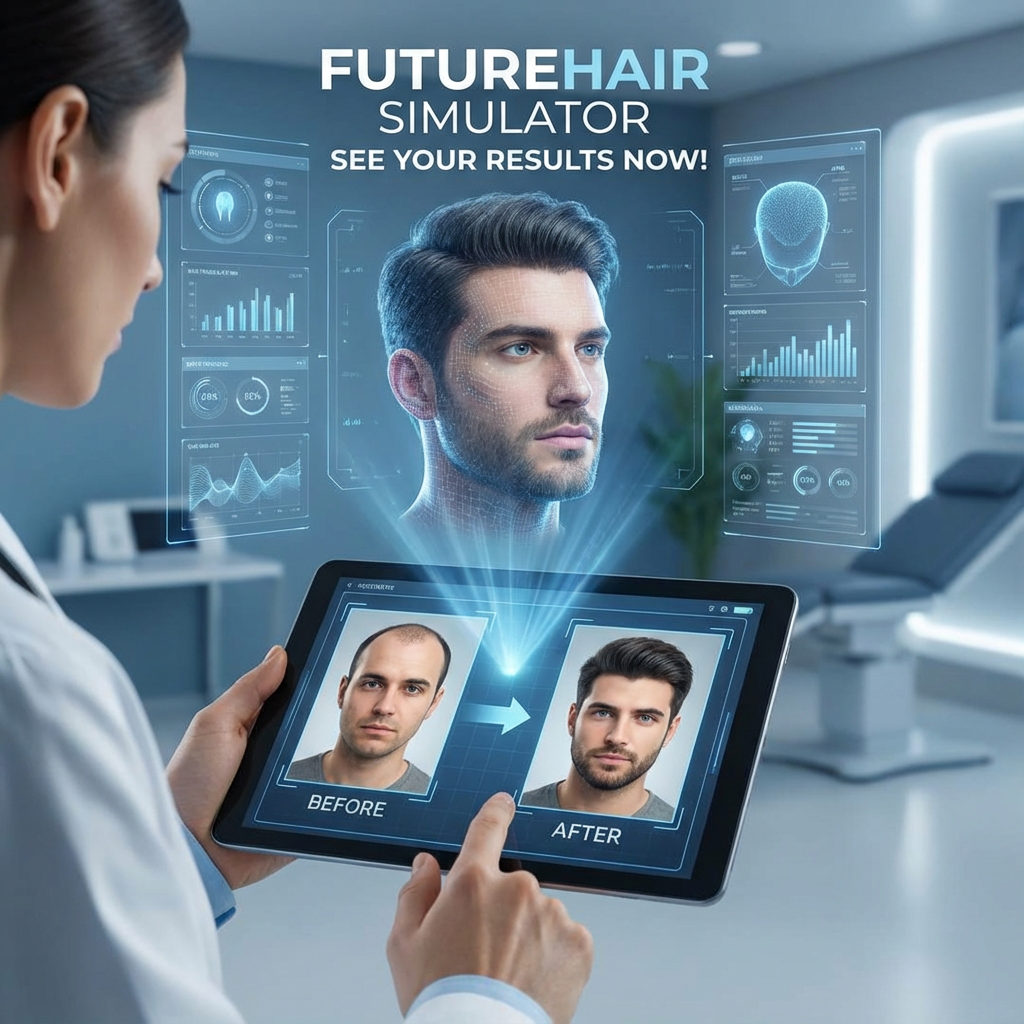
The Power of the AI Hair Transplant Simulator Free of Charge
Accessibility is at the heart of our mission. In the past, high-quality 3D modeling was locked behind expensive clinical consultation fees. We believe that every individual deserves to know their potential results before spending a single dollar. Our AI hair transplant simulator free tool democratizes hair restoration, allowing you to experiment with different hairlines, densities, and styles from the comfort of your home.
Unlike basic filters found on social media, our simulator is built on a dataset of over 500,000 successful clinical outcomes. When you upload your photo, our AI doesn’t just “paint” hair onto your head; it analyzes your:
- Facial Bone Structure: To ensure the hairline is anatomically correct.
- Forehead Proportions: To maintain the “Golden Ratio” of aesthetic beauty.
- Native Hair Texture: So the simulated grafts match your natural curl and thickness.
Virtual Hair Transplant Simulation: Realism Beyond Imagination
The core technology of our site revolves around a high-fidelity virtual hair transplant simulation. In 2026, the standard for “realistic” has been raised. Our engine utilizes Generative Adversarial Networks (GANs) to render hair that reacts to light and shadow just like the real thing.
When you use our Hair Transplant Visualization Guide, you aren’t looking at a static mask. You are looking at a 4K digital twin of yourself. You can rotate the model 360 degrees to see how your crown will look from a bird’s-eye view or how your temples will frame your face from a profile angle. This immersive virtual hair transplant simulation ensures that there are no “blind spots” in your transformation plan.
Why Every Patient Needs a Hair Transplant Simulation Before Surgery
The most successful surgeries are the ones where the patient and the doctor are on the exact same page. Using a Hair transplant simulation before you visit a clinic puts the power back in your hands. It allows you to become an active participant in your own surgical design.
By bringing your results from our Hair transplant simulation before your consultation, you can show your surgeon exactly what you expect. This eliminates the “communication gap” that often leads to hairlines that are too straight, too low, or too high. Our tool serves as the ultimate bridge between your vision and the surgeon’s execution, ensuring that the final result is exactly what you saw on your screen.
Hair Transplant Simulator: Technology That Lets You See Your Results Before Your Hair Transplant
Deciding to have a hair transplant is not an easy process for most people. Questions such as what the hairline will look like, whether the transplanted grafts will look natural, and whether the density will be sufficient often linger in people’s minds. This is precisely why hair transplant simulator technology has gained significant attention in recent years. This software simplifies the decision-making process by realistically modelling how you will look after a hair transplant using your own photograph.
One of the most significant advantages offered by the simulator is that you can visualise the results before undergoing the procedure. In the past, doctors and clinics would typically show patients reference photos. However, since every face shape, hair type, and level of hair loss is different, these references were often insufficient. The hair transplant simulator, on the other hand, produces personalised results. This means you now have the opportunity to see how it will look on your own face, not someone else’s.
Precision Mastery: The AI Hair Transplant Simulation Engine
What sets our site apart from the competition is the depth of our AI Hair Transplant Simulation engine. We don’t just show you “more hair”; we show you a “surgical plan.” Our AI is programmed with real biological constraints used by the world’s leading FUE and DHI surgeons.
Key features of our AI Hair Transplant Simulation include:
- Graft Count Estimation: Our AI calculates the approximate number of grafts needed to achieve the look you’ve designed.
- Donor Impact Analysis: The system warns you if your desired density might over-harvest your donor area.
- Multi-Technique Comparison: See the difference in appearance between a standard FUE and a high-density DHI approach.
[Table: Why Our AI Simulation Leads the 2026 Market]
| Feature | Competitor Tools | Our AI Simulation Platform |
| Rendering Quality | 720p / Static | 4K / 360° Interaction |
| Scientific Accuracy | Visual only | Biometric & Anatomical Analysis |
| Mobile Access | Requires high-end PC | Optimized for all Smartphones |
| Cost | Often paid or “Lite” versions | Full AI hair transplant simulator free |
| Medical Integration | None | Exportable reports for surgeons |
Perfecting the Look: Hair Transplant Design Simulation
Design is where a transplant succeeds or fails. A straight, “wall-like” hairline is the most common sign of an amateur transplant. Our Hair Transplant Design Simulation tool is programmed with “Artistic Chaos” algorithms. This means the AI suggests hairlines with micro-irregularities, mimicking the way real hair grows in randomized clusters.
With the Hair Transplant Visualization Guide, you can:
- Adjust the “Apex”: Find the perfect height for your central hairline.
- Close the Temples: See how “filling in the corners” changes your facial symmetry.
- Density Zoning: Choose where you want the most coverage—whether it’s the frontal “money piece” or the crown.This level of Hair Transplant Design Simulation ensures that your results look like they grew there naturally, not like they were “installed” by a machine.
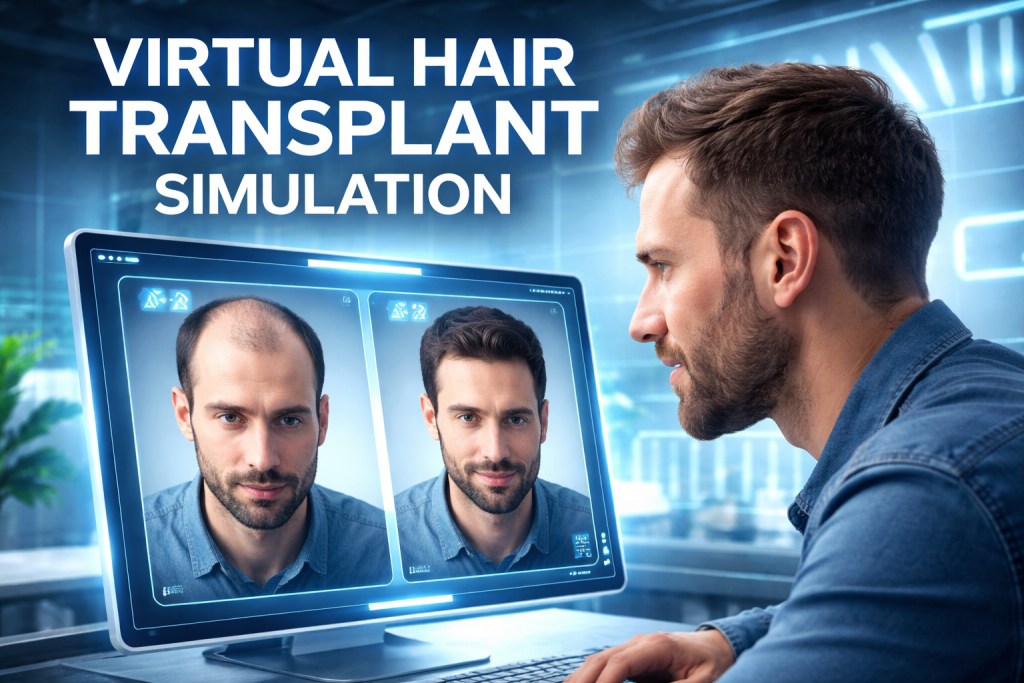
The 2026 User Experience: 3 Steps to Your New Look
We have streamlined our site to ensure that you can go from “thinning” to “simulated” in less than 60 seconds. Our user-friendly interface is designed for everyone, regardless of technical skill.
- Step 1: Upload. Take a few selfies from different angles. Our AI will automatically stitch them into a 3D head model.
- Step 2: Design. Use our intuitive sliders to adjust your hairline and density. This is where your Hair Transplant Design Simulation comes to life.
- Step 3: Analyze. Receive a full report detailing your graft count, simulated results, and personalized hair health advice.
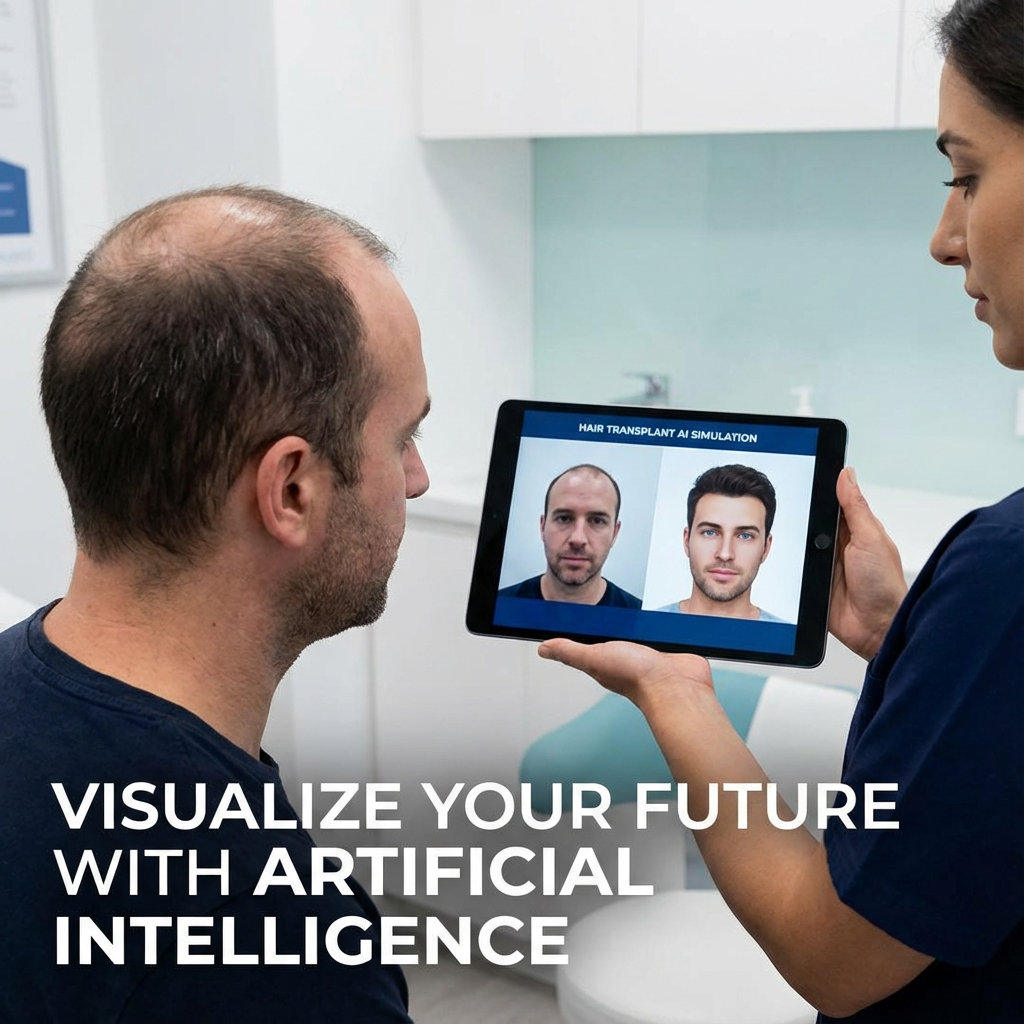
Bridging the Gap: From Simulation to Reality
Our site does more than just show you a pretty picture. We help you take the next step. Once you are happy with your virtual hair transplant simulation, you can export your 3D design and share it directly with our network of certified 2026 “High-Fidelity” clinics.
By starting with our AI Hair Transplant Simulation, clinics can provide you with a more accurate quote and a faster consultation. They know you are an educated patient who understands the possibilities and limitations of the procedure. This professional-grade integration is why we are the preferred partner for both patients and surgeons in the current year.
Unlock Your Ultimate Look: The Precision of Our 2026 AI Hair Style Simulator
Our platform’s Hair Style Simulator has redefined the way you approach personal grooming by blending high-performance generative AI with hyper-realistic 3D rendering tailored specifically for our community. Unlike basic filter apps, our 2026 simulator allows you to virtually “test drive” thousands of cuts, textures, and the latest trending colors with a click, all while accounting for your unique facial symmetry and hair type to ensure every style looks authentically yours. Whether you’re preparing for a dramatic transformation or simply looking to refine your current look, our tool serves as the ultimate digital mirror, providing you with the confidence to walk into your next salon appointment with a pixel-perfect vision of your new identity.
Conclusion: Don’t Leave Your Hair to Chance
A hair transplant is a permanent change. Why would you ever go into surgery without seeing the result first? Our site provides the most powerful, accurate, and user-friendly AI Hair Transplant Simulation available in 2026.
From our Hair Transplant Visualization Guide that offers 4K realism to our Hair Transplant Design Simulation that ensures artistic perfection, we have built the ultimate toolkit for the modern patient. Experience the future of hair restoration today with our AI hair transplant simulator free tool and take the first step toward the look you’ve always wanted. Your journey starts here, at the intersection of human artistry and artificial intelligence.
Hair Transplant Simulation
It is a professional digital preview of your hair restoration result using AI. It analyzes your photos to show how your hair will look after a transplant or SMP, providing a clear roadmap for your transformation.
To avoid mistakes. It helps you finalize your hairline and density goals independently, ensuring you don’t walk into surgery with unrealistic expectations or an ill-suited design.
Yes, our AI uses biometric data and surgical standards to create a realistic outcome. It is far more reliable than standard editing apps because it respects your actual skull shape and donor hair quality.
Certainly. By mapping the thinning area and setting the desired density, the simulator provides an objective graft estimate, helping you compare clinic quotes more effectively.
Yes! You can test multiple heights and shapes to find the most flattering and natural hairline for your face before any permanent work is done by a surgeon.
While focusing on the final result, the simulation process helps you visualize the 12-month goal, making the temporary shedding or “shock loss” phase much easier to handle mentally.
Absolutely. It can simulate the “shaven look” or “density effect” of Scalp Micropigmentation, allowing you to choose between surgery or non-surgical pigmentation based on visual results.
By identifying if a design is anatomically incorrect or if expectations exceed donor supply. A simulation acts as a safety check before you make a major financial and physical commitment.
Yes, we encourage it. Handing a visual blueprint to your surgeon reduces communication errors and ensures the surgical team understands your specific aesthetic vision.
Yes, it is highly valuable for women to see how a transplant or SMP can fill in thinning part-lines and restore volume, providing a clear preview of the hair’s potential fullness.