The Golden Ratio in Aesthetics: Hair Transplant Design Simulation and Hairline
Deciding to undergo a hair transplant is not just about getting new hair, but also about redesigning your reflection in the mirror. While many people focus on the technical aspects of the procedure, the most critical artistic touch that determines the success of the outcome is the hairline. An improperly planned hairline can result in an unnatural appearance, regardless of how many hairs are transplanted. This is where Hair Transplant Design Simulation and Hairline Planning, the greatest gift of modern technology, come into play.
The Secret to a Natural Look: Personalised Design
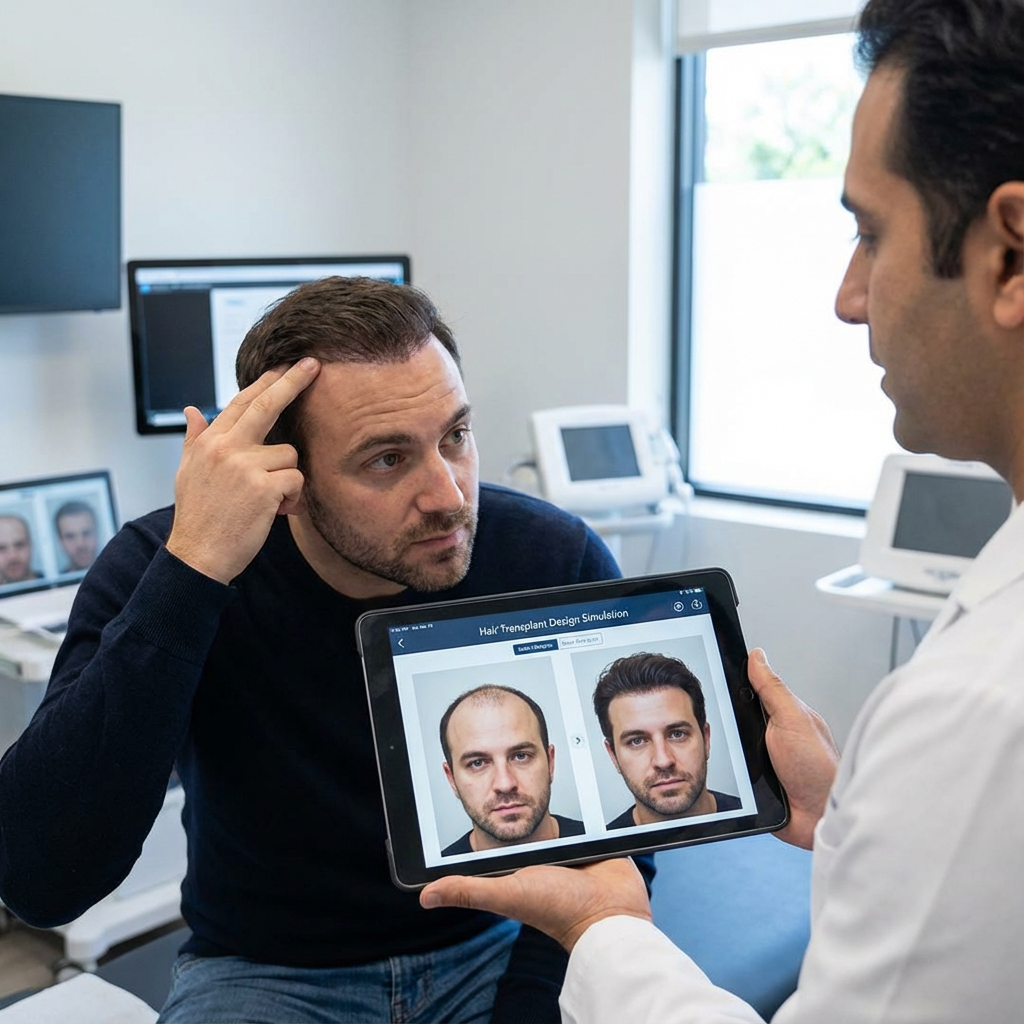
Every person’s forehead structure, muscle movements and facial bone structure are different. Drawing the same line for everyone using a standard ruler measurement means straying from naturalness. This technology analyses the golden ratio on the person’s face. By digitally determining the most suitable line for your age, head shape and hair loss type, it ensures that you achieve a result where it is not obvious that a transplant has been performed after the operation.
How Does the Simulation Process Work?
During this process, it is not merely a matter of drawing a line; the direction, angle, and density of hair growth are also calculated. Thanks to Hair Transplant Design Simulation and Hairline, the visual density that the grafts to be transplanted will create is simulated in advance. The patient sees what kind of change they will experience when they look in the mirror before any procedure is performed. This increases the patient’s confidence in the operation and allows the doctor to work with millimetric precision.
Why Digital Simulation?
In traditional methods, a higher margin of error exists when following a line drawn with a pen on the day of the operation. However, when Hair Transplant Design Simulation and Hairline are used:
- Muscle movements in the forehead area are taken into account (so that the hairline looks natural when talking or raising the eyebrows).
- Transitions in the temple areas are optimised according to the width of the face.
- Hair density is adjusted as realistically as possible according to the capacity of the donor area.
Look into the Mirror of the Future Today
Hair transplantation is a difficult and laborious process. Therefore, rather than leaving it to chance, choosing this method, which is supported by scientific data, is the most logical step. A well-designed hairline can make you look younger and more dynamic, while a poorly designed one can turn into a lifelong regret.
Ultimately, hairline solutions that combine aesthetics and technology offer you a concrete guarantee to achieve your dream look. Remember, the best hair transplant is one where the transplant is not noticeable.
Hairline Design & Simulation FAQ
It is the “frame” of your face. A proper design ensures symmetry and a natural look that matches your age and facial structure.
Simulation provides a digital “test drive” of your new look, allowing you to approve the shape and height before the procedure starts.
It’s a mathematical principle used to find the most balanced position for your hairline relative to your facial features.
Yes, SMP is perfect for adding crisp definition and visual density to a transplanted or naturally thinning hairline.
No. Natural hairlines have subtle irregularities. We design them with a soft, natural flow to avoid the “pluggy” or artificial look.
We consider your age, future balding risk, and facial muscles to place the hairline where it will look best for decades to come.
Yes, we specialize in softer, rounded female hairline designs that restore density to thinning temples while keeping a feminine look.
At hairsimulate.com, we use multi-angle modeling to ensure your design looks perfect from the front, profile, and top view.
SMP is applied in layers, so we can refine the softness and density during your follow-up sessions for the ultimate natural finish.
Visit hairsimulate.com for a professional design consultation using the world’s most advanced hair simulation technologies.