Structural Degradation: A Scientific Analysis of the Effects of Heat and Hair Dyes on Hair
In the field of trichological research, the human hair shaft is regarded as a complex biopolymer composed primarily of alpha-keratin proteins, lipids, and melanin pigments. While the cortex provides tensile strength and elasticity, the overlapping scales of the cuticle serve as a protective barrier against environmental insults. However, modern aesthetic practices often involve the repeated application of high-temperature styling and oxidative chemical treatments. To preserve the structural integrity of the fiber, it is essential to understand the microscopic effects of heat and hair dyes on hair and how these stressors induce permanent changes at the molecular level.
This article dissects the mechanism of protein denaturation, lipid depletion, and cystine bond rupture, providing a 2026 perspective on mitigating hair damage.
1. The Morphological Impact of Thermal Stress
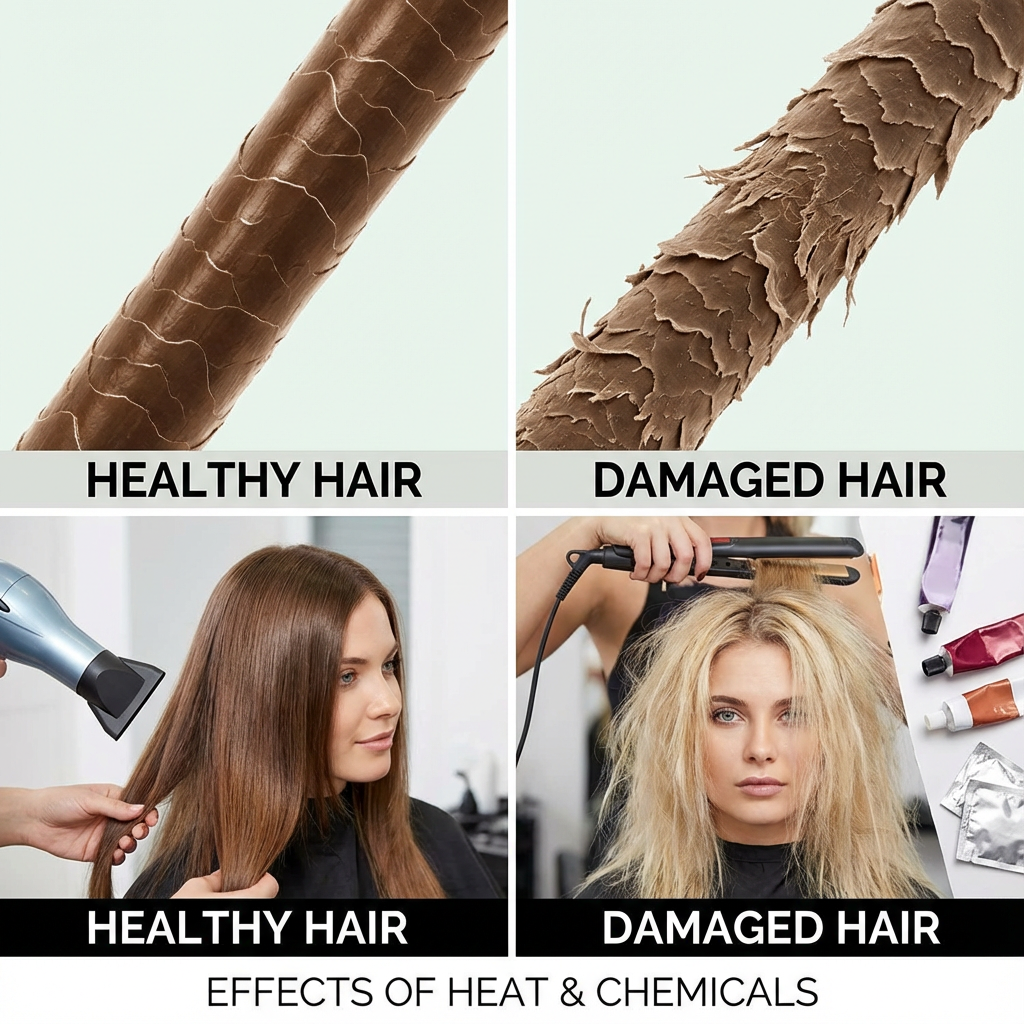
Heat styling tools, such as flat irons and blow dryers, can reach temperatures exceeding 200°C. When discussing the effects of heat and hair dyes on hair, one must first address the “glass transition temperature” of keratin. Hair contains a specific amount of “bound water” that maintains its flexibility.
When excessive heat is applied, this water undergoes rapid evaporation, leading to the formation of “bubble hair”—a condition where steam is trapped within the hair shaft, creating vacuoles that weaken the structure. Furthermore, temperatures above 150°C begin to denature the alpha-helix keratins, converting them into a disordered beta-sheet conformation. This transition results in a loss of elasticity, making the hair brittle and prone to longitudinal splitting, known as trichoptilosis.
2. Chemical Alteration: The Role of Oxidative Dyes
Hair coloring is a process of controlled chemical trauma. Permanent dyes rely on a combination of ammonia (or ethanolamine) and hydrogen peroxide to penetrate the cuticle. Ammonia raises the pH of the hair, causing the cuticle scales to lift and swell. Subsequently, hydrogen peroxide enters the cortex to oxidize the natural melanin and develop new pigment molecules.
A significant portion of the effects of heat and hair dyes on hair involves the degradation of the “F-layer.” The F-layer is a thin coating of 18-methyleicosanoic acid (18-MEA) that makes the hair hydrophobic (water-repellent). Oxidative dyes strip this lipid layer, turning the hair hydrophilic. Once the F-layer is lost, the hair absorbs water too easily, leading to “hygral fatigue”—the repeated swelling and deswelling of the hair fiber that eventually causes the cuticle to lift and break away.
3. Disulfide Bond Rupture and Cysteic Acid Formation
The strength of the hair fiber is largely derived from disulfide bonds (S-S bonds) between cysteine residues. One of the most detrimental effects of heat and hair dyes on hair is the irreversible breaking of these covalent bonds.
During the bleaching or coloring process, the oxidative environment converts some of the sulfur atoms into cysteic acid. Unlike disulfide bonds, cysteic acid cannot be reformed, and its presence correlates directly with a decrease in the hair’s tensile strength. High heat accelerates this oxidative process. If a patient uses high-temperature tools immediately after a chemical color service, the rate of cysteic acid formation increases exponentially, leading to “chemical melting” or severe breakage where the hair loses its structural “memory” and becomes gummy when wet.
4. Melanin Degradation and Photodamage
Melanin is not just a pigment; it is a photoprotective agent that absorbs and scatters UV radiation. However, both heat and chemical dyes compromise this protection. When hair is dyed, the natural melanin is partially or fully destroyed to make room for synthetic pigments.
Synthetic pigments are significantly less stable than natural eumelanin and pheomelanin. Consequently, one of the synergistic effects of heat and hair dyes on hair is an increased vulnerability to UV-induced protein degradation. Without natural melanin to act as a buffer, the sun’s radiation can further break down the peptide chains in the cortex, leading to the “brassiness” and rapid color fading often seen in chemically treated and heat-styled hair.
5. Cuticle Erosion and Porosity Changes
The cuticle is the hair’s first line of defense. Healthy hair has low porosity, meaning the cuticle scales lie flat and tight. The combined effects of heat and hair dyes on hair lead to a condition known as “high porosity.”
Repeated heat exposure causes the edges of the cuticle scales to curl upward, while chemical dyes erode the “cement” (the cell membrane complex) that holds these scales together. Over time, sections of the cuticle may be completely lost, exposing the vulnerable cortex to the environment. This high porosity makes it difficult for the hair to retain moisture, leading to a perpetual cycle of dryness, frizz, and tangling that cannot be corrected by simple conditioners alone.
6. Mitigation Strategies: Bond Builders and Thermal Protectors
In 2026, the scientific approach to managing the effects of heat and hair dyes on hair has moved toward “biomimetic repair.”
- Bond Builders: These are small molecules (like bis-aminopropyl diglycol dimaleate) that can penetrate the cortex and create artificial bridges between broken disulfide bonds, temporarily restoring some of the hair’s lost strength.
- Thermal Protectors: Modern heat protectants utilize polymers like VP/VA copolymers and hydrolyzed proteins. These substances form a sacrificial film on the hair surface, distributing the heat more evenly and slowing down the rate of thermal conduction to the inner cortex.
- Acidic Rinse Therapy: Since dyes raise the pH of the hair, using acidic products (pH 3.5-4.5) after coloring helps to flatten the cuticle and re-seal the hair shaft, partially restoring its refractive index and shine.
7. The Future of Hair Health: Cold-Process Dyes and AI Heat Control
As technology advances, we are seeing the emergence of cold-process hair dyes that use ultrasound or specialized enzymes to deposit pigment without the need for high-pH ammonia. Simultaneously, professional styling tools are now equipped with AI sensors that measure the hair’s moisture content in real-time, automatically adjusting the temperature thousands of times per second to prevent reaching the glass transition point of keratin. These innovations are designed to allow for aesthetic expression while neutralizing the most severe biological consequences of our styling habits.
8. Conclusion: A Balanced Approach to Trichology
The desire for aesthetic change is a fundamental aspect of human expression, but it comes at a biological cost. By understanding the microscopic effects of heat and hair dyes on hair, both clinicians and consumers can make more informed decisions. The key to maintaining healthy hair in a world of heat and chemicals lies in the preservation of the F-layer, the protection of disulfide bonds, and the strategic use of advanced “repair” molecules. As we move forward, the goal of hair science is not to banish heat or color, but to engineer products that protect the delicate keratin architecture of the hair from the inside out.
Heat, Dye & Scalp Health FAQ
Temperatures above 175°C damage the hair cuticle and break keratin bonds, leading to dryness, split ends, and brittle strands that snap easily.
Dye usually causes “chemical breakage” rather than killing the follicle. However, chronic scalp irritation from harsh dyes can lead to temporary thinning.
Yes, but you must wait 4 weeks. This allows the scalp to heal completely so the chemicals in the dye don’t interfere with the new pigments.
Standard styling doesn’t fade healed SMP since pigments are under the skin. Avoid direct high-heat contact with the scalp during the first 10 days.
Absolutely. Hair simulation is a top-tier solution for camouflaging thin patches caused by over-processing or heat-induced breakage.
Once fully healed, blow-drying is fine. We recommend using a cool setting to preserve both your natural hair quality and scalp moisture.
Ammonia-free and botanical dyes are the best choice. They are far less likely to irritate the scalp or cause the hair shaft to become brittle.
Yes, both hair dye and SMP pigments can fade with sun exposure. Always use a hat or scalp-safe sunscreen for long-term vibrancy.
Wait at least 10 days. Using high-heat tools too early can pull at scabs or irritate the healing skin, potentially affecting your results.
Chemical dyes can dry out the scalp. A healthy, moisturized scalp ensures your hair simulation remains crisp and blends seamlessly with your hair.