Navigating the Choice: A Deep Dive into DHI vs FUE Hair Transplant
Deciding to undergo a hair restoration procedure is a life-changing moment. It is the point where you move from managing hair loss to actively reversing it. However, once you decide to take the leap, you are immediately met with a technical crossroads. In the world of modern clinics in 2026, the conversation almost always centers on one major comparison: dhi vs fue hair transplant.
Both methods have replaced the outdated “strip” surgeries of the past, offering scar-free results and high success rates. Yet, they are fundamentally different in how they handle your precious hair follicles. To make the right choice, you need to look beyond the marketing and understand the biological and surgical realities of each method. This guide provides a comprehensive 1,000-word analysis to help you navigate this choice with absolute clarity.
1. The Core Philosophy of FUE
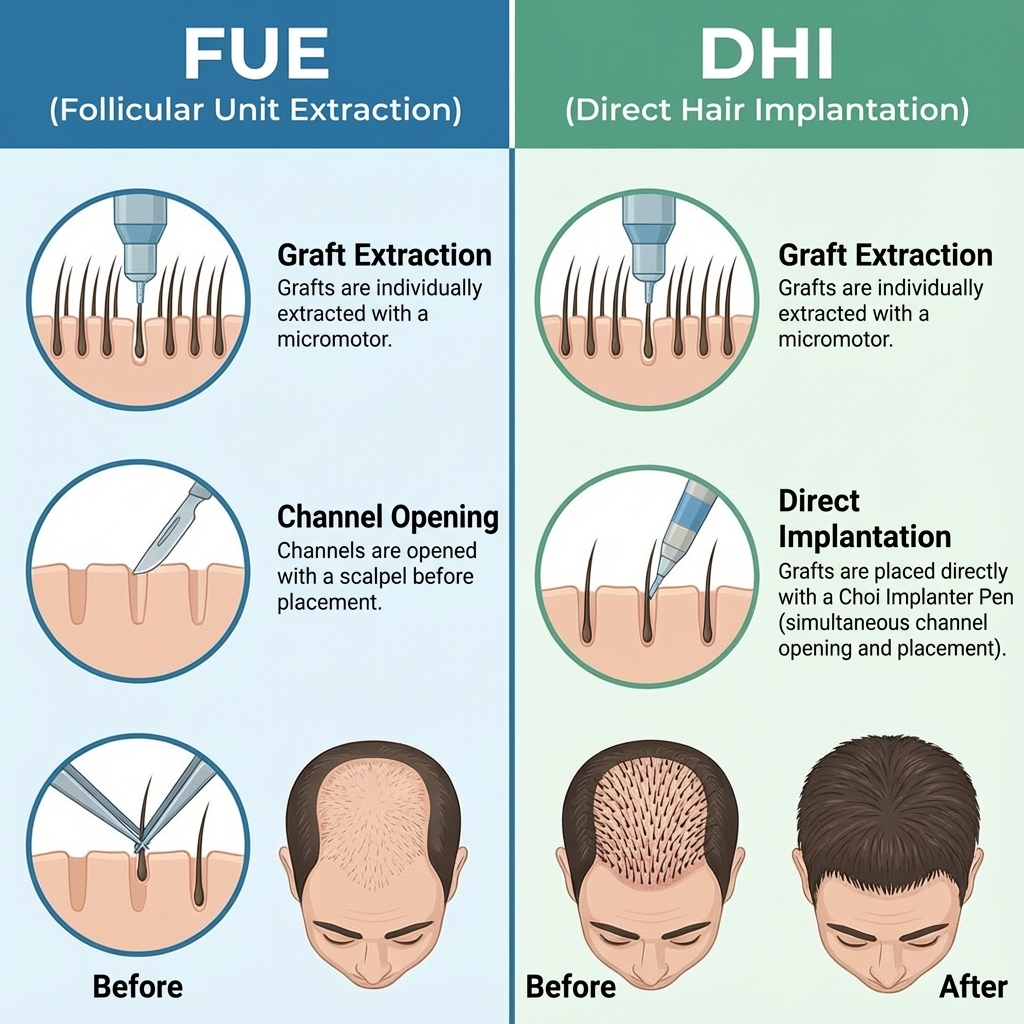
FUE (Follicular Unit Extraction) is the foundation of modern hair restoration. Its philosophy is built on “isolation and distribution.” By extracting individual follicles from the donor area, surgeons can move hair without leaving a linear scar.
The most critical phase of FUE is the “channel opening” phase. Using a sapphire or steel blade, the surgeon creates a roadmap on the recipient area. This determines the overall flow and pattern of the new hair. Once these tiny slits are made, the extracted grafts are placed into them using fine forceps. Because this method allows for a high volume of grafts to be processed quickly, it remains the standard for patients who have significant hair loss across the entire scalp.
2. The DHI Innovation: Why “Direct” Matters
When we look at the evolution in the dhi vs fue hair transplant debate, DHI (Direct Hair Implantation) represents the refinement of the process. The core philosophy here is “minimal handling and maximum precision.”
Instead of opening a channel and then placing a hair, DHI uses the Choi Implanter Pen to do both at once. This isn’t just a matter of saving time; it’s about the health of the follicle. Hair follicles are living organs, and every second they spend outside the body—and every time they are touched by surgical tools—their survival rate drops slightly. By eliminating the manual placement with forceps, DHI ensures that the hair is protected during the most vulnerable stage of the surgery.
3. Comparing the Donor Area Management
In any hair transplant, your donor hair is a finite resource. You only have a certain amount of hair that can be safely moved. In the dhi vs fue hair transplant comparison, how these follicles are harvested and managed is key.
In FUE, the extraction is often done with a focus on speed and volume. This is great for covering large areas, but it usually requires the entire donor area to be shaved to 1-2mm. DHI, on the other hand, is much more adaptable. Because the implantation tool is so precise, many surgeons use it for “partial shave” or “unshaven” procedures. This is a massive benefit for people who want to keep their surgery a secret from colleagues and friends.
4. The Art of the Hairline
The hairline is the most visible part of a hair transplant. If the hairline looks “fake,” the entire procedure is considered a failure. This is where the dhi vs fue hair transplant choice becomes an artistic one.
FUE creates a very consistent look, but because the channels are pre-cut, there is a slight limit to how close the hairs can be placed without the tissue “popping.” DHI allows for incredible density. The Choi pen allows the surgeon to place hairs in between existing strands with microscopic accuracy. If you are looking to lower your hairline by just an inch or fill in a small receding patch with maximum thickness, DHI is widely considered the superior tool for that level of “high-definition” artistry.
5. Recovery: The First Seven Days
What happens in the week following your surgery? In the dhi vs fue hair transplant debate, recovery is a major selling point.
- FUE Recovery: Because channels are pre-opened, there is more widespread trauma to the skin. You can expect more significant swelling (edema) and a longer period of scabbing. Most FUE patients feel “back to normal” in about 7 to 10 days.
- DHI Recovery: Since the “wounds” are exactly the size of the hair follicle being implanted, the trauma is localized. Bleeding is minimal, and scabs are often so small they are barely visible. DHI patients often report feeling ready to return to social activities within 3 to 4 days.
6. Understanding the Price vs. Value Gap
It is no secret that DHI is the more expensive option. When you look at the dhi vs fue hair transplant price list, DHI can be 20% to 50% more costly. This is because DHI is “high-touch.” It requires a team of 3-4 technicians working in perfect sync with the surgeon to load the pens.
However, “value” is different from “price.” If DHI results in a 10% higher graft survival rate, or if it saves you from having to shave your head for a high-stakes job, the extra investment pays for itself. You have to decide if the technical advantages of DHI match the specific needs of your lifestyle.
7. The Role of Technology in Decision Making
By 2026, we are no longer making these choices in the dark. Advanced hair transplant simulation tools allow you to compare these two methods digitally.
A simulation can show you the difference between the “Global Coverage” of FUE and the “High Density” of DHI on your own face. This visual aid is crucial. It helps you see if your specific hair loss pattern actually requires the high-density approach of DHI or if the broad coverage of FUE will give you a better overall balance.
8. Biological Longevity: Will the Results Last?
A common myth in the dhi vs fue hair transplant discussion is that one lasts longer than the other. The truth is that both methods use “permanent” hair from the donor zone. These hairs are genetically resistant to DHT (the hormone that causes balding).
Whether they are moved via FUE or DHI, once they take root, they will grow for the rest of your life. The longevity isn’t about the method; it’s about the skill of the surgeon in selecting the right follicles and the patient’s commitment to post-op care.
9. Conclusion: Making Your Final Choice
The battle of dhi vs fue hair transplant isn’t about which one is “better” in a vacuum—it’s about which one is better for you.
If you have a limited budget and a large area of baldness, FUE is a tried-and-true workhorse that will give you a fantastic transformation. If you are looking for a discreet, high-density, and fast-healing procedure to fix specific thinning areas, DHI is the premium choice that offers unparalleled precision.
The most important thing to remember is that you are living in the best era in history for hair restoration. No matter which path you choose, the technology of 2026 ensures that you don’t have to live with hair loss any longer.
DHI vs. FUE Hair Transplant FAQ
DHI uses a Choi Pen to implant hair directly without pre-opening channels, whereas FUE involves opening channels before graft placement.
DHI is excellent for precision, but for the ultimate high-density look, many choose to enhance their results with Scalp Micropigmentation (SMP).
Generally, yes. DHI involves less skin trauma, leading to a slightly quicker healing process and less scabbing than traditional FUE.
DHI is the preferred method for unshaven transplants, as it allows for precise implantation between existing long hairs.
Both are minimally invasive. Any small dot scars in the donor area can be easily hidden with professional hair simulation (SMP).
Yes, due to the specialized Choi Pen equipment and the more intensive manual labor required from the medical team.
Absolutely. SMP is the most effective way to add visual density and fix “patchy” results after an FUE or DHI procedure.
FUE is typically used for larger sessions (4,000+ grafts), while DHI is often limited to around 2,500-3,000 grafts per session.
Yes, curly hair can sometimes be better handled with FUE. A professional analysis is key to choosing the right method for your hair texture.
The best aesthetic outcome usually comes from a hybrid approach: choosing the right surgery and perfecting the density with hair simulation.