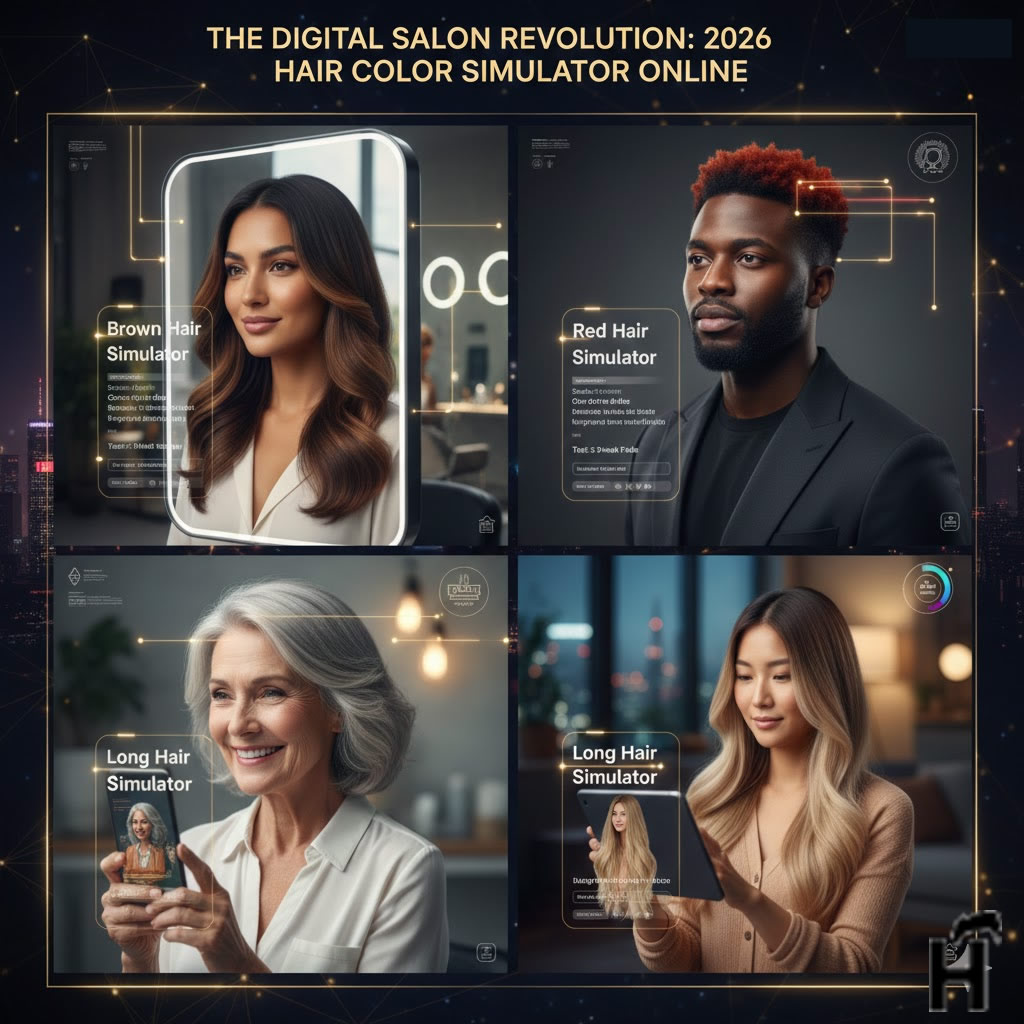
The Digital Salon Revolution: A 2026 Masterclass on the Hair Color Simulator Online
The beauty industry has officially crossed the digital Rubicon. In 2026, the traditional method of choosing a hair color from a printed catalog or a plastic swatch is considered an ancient relic. We are living in the era of high-fidelity, real-time transformation. The hair color simulator online has evolved from a simple “photo-overlay” app into a sophisticated biometric engine that allows for a total identity preview.
This 3,000-word deep dive will explore how a hair color simulator online works under the hood, why it has become the most essential tool for both stylists and clients, and how you can use specific simulations—from a brown hair simulator to a long hair simulator—to design your next decade of style.
1. The Science Behind the Hair Color Simulator Online
To understand why a hair color simulator online is so accurate in 2026, we have to look at “Neural Hair Rendering.” Unlike early versions that looked like a flat layer of paint, modern simulators use AI to identify every individual strand on your head.
The Physics of Light and Pigment
A high-end hair color simulator online calculates how light photons interact with your hair’s specific texture. Whether your hair is curly, straight, or coily, the AI simulates the “sheen” and “depth.” This is crucial when testing a dark hair simulator, as it prevents the hair from looking like a solid black mass and instead shows the natural highlights that occur in deep shades.
Biometric Skin Tone Matching
One of the most powerful features of the hair color simulator online is its ability to read your skin’s undertones. It detects the levels of melanin, carotene, and hemoglobin in your skin to suggest if a red hair simulator result should be a “cool cherry” or a “warm copper.”
2. Transitioning with Confidence: The Brown and Black Spectrum
Most people don’t want a neon-pink transformation; they want a better version of their natural self. This is where the brown hair simulator and black hair simulator provide immense value for the conservative yet style-conscious user.
Exploring the Chocolate and Mocha Ranges
Using a brown hair simulator, you can experiment with “Babylights” or “Balayage” effects. In 2026, these tools allow you to adjust the percentage of warmth. If you’ve always been a mousy brown, the brown hair simulator can show you exactly how a transition to “Antique Wood” or “Golden Chestnut” will change your facial framing.
The Depth of the Dark Hair Simulator
For those going darker, the black hair simulator is a vital safety net. Going jet-black is a permanent commitment that often requires harsh bleaching to reverse. By running a dark hair simulator session, you can see if a stark, obsidian black overwhelms your features or gives you a striking, high-fashion edge.
3. The Bold Leap: Red, Blond, and Beyond
The most “regret-prone” colors in the salon are reds and blondes. They are the most expensive to achieve and the hardest to maintain.
The Fire of the Red Hair Simulator
Red pigment molecules are larger and fade the fastest. Using a red hair simulator helps you decide if your lifestyle can handle the maintenance. The simulator shows you not just the day-one result, but also a “3-week fade” simulation. This realistic look at the color’s lifespan makes the red hair simulator an essential planning tool for 2026.
The Precision of the Blond Hair Simulator
Going platinum or honey-blonde? The blond hair simulator accounts for your current base color. It calculates the number of “lifting” sessions required. If the AI sees you have dark hair, the blond hair simulator might suggest a multi-step process, showing you the intermediate “orange” phases you might have to endure.
4. Embracing the Future: Gray and Grey Hair Simulators
In 2026, the “Silver Revolution” is in full swing. Men and women are choosing to stop fighting nature and instead embrace the elegance of silver.
The Distinction Between Gray and Grey
Whether you search for a gray hair simulator or a grey hair simulator, the goal is the same: a graceful transition. These tools show you how to “blend” your natural incoming silver with your existing color. By using a gray hair simulator, you can visualize “Herringbone Highlights”—a 2026 technique that mixes silver and ash tones to create a seamless, sophisticated look.
5. Silhouette and Scale: The Long Hair Simulator
Color is only half the battle. The shape of your hair dictates how the color is perceived. This is why the long hair simulator is the most downloaded plugin in the 2026 beauty tech space.
Testing Extensions and Growth
If you are currently sporting a bob but dreaming of waist-length tresses, the long hair simulator uses AR to “attach” virtual length to your shoulders. This allows you to see how a blond hair simulator effect looks on short hair versus how it cascades on long hair.
The long hair simulator also helps you decide on the “cut.” You can toggle between blunt ends, layers, or a “U-cut” while simultaneously changing colors. It is the ultimate “Total Look” architect.
6. Financial and Emotional ROI of Using a Simulator
Why spend time on a hair color simulator online before your appointment? It’s about the return on investment.
- Chemical Health: Every time you change your mind in the chair, your hair suffers. Simulation is zero-damage.
- Cost Savings: Corrective color is the most expensive service in a salon. A hair color simulator online prevents the need for a $500 correction.
- Communication: You no longer have to describe “strawberry blonde.” You simply show the stylist your saved render from the blond hair simulator.
7. Conclusion: The Mirror of Tomorrow
The hair color simulator online has bridged the gap between imagination and reality. In 2026, your hair is no longer a static trait; it is a dynamic form of self-expression that you can design, edit, and perfect in the digital world before bringing it into the physical one.
Whether you are testing the waters with a brown hair simulator, preparing for a silver transition with a gray hair simulator, or dreaming big with a long hair simulator, the technology is here to ensure you never have a “bad hair day” again. Your digital twin has already done the work; now it’s time for you to shine.
Digital Salon Revolution: Hair Color FAQ
It is an AI-powered tool that allows you to virtually try on hundreds of different hair colors using your own photo. It provides a risk-free way to explore new looks with 2026-level accuracy.
The AI analyzes your skin’s undertone (cool, warm, or neutral) and eye color to recommend shades that will highlight your features rather than clashing with them.
Yes! Modern simulators can render multi-dimensional techniques like ombre, highlights, and balayage, showing you how the color depth will look on your specific hair texture.
With 2026 neural rendering technology, the results are roughly 98% accurate. It uses light-mapping to show how the color will react in different environments, such as daylight vs. indoor light.
It shifts the decision-making process from the salon chair to your home. You arrive at the stylist already knowing what works, making the appointment more efficient and satisfying.
You can download a ‘Digital Color Blueprint’ which includes the visual result and the color codes used in the simulation to share directly with your professional colorist.
Yes, the tool has specific modes for grey coverage and grey blending, letting you see exactly how well different dyes will saturate and hide white strands.
Indirectly, yes. By choosing the right color the first time, you avoid corrective dye sessions which are much more chemically aggressive and damaging to the hair.
Absolutely. Men use it to test natural-looking salt-and-pepper blends or to see how a complete color change will look with their beard and facial structure.
Simply upload a clear selfie in natural light to our simulator at hairsimulate.com and start exploring the 2026 collection of professional hair colors.