Follicular Geometry: The Scientific Differences Between Curly and Straight Hair Care
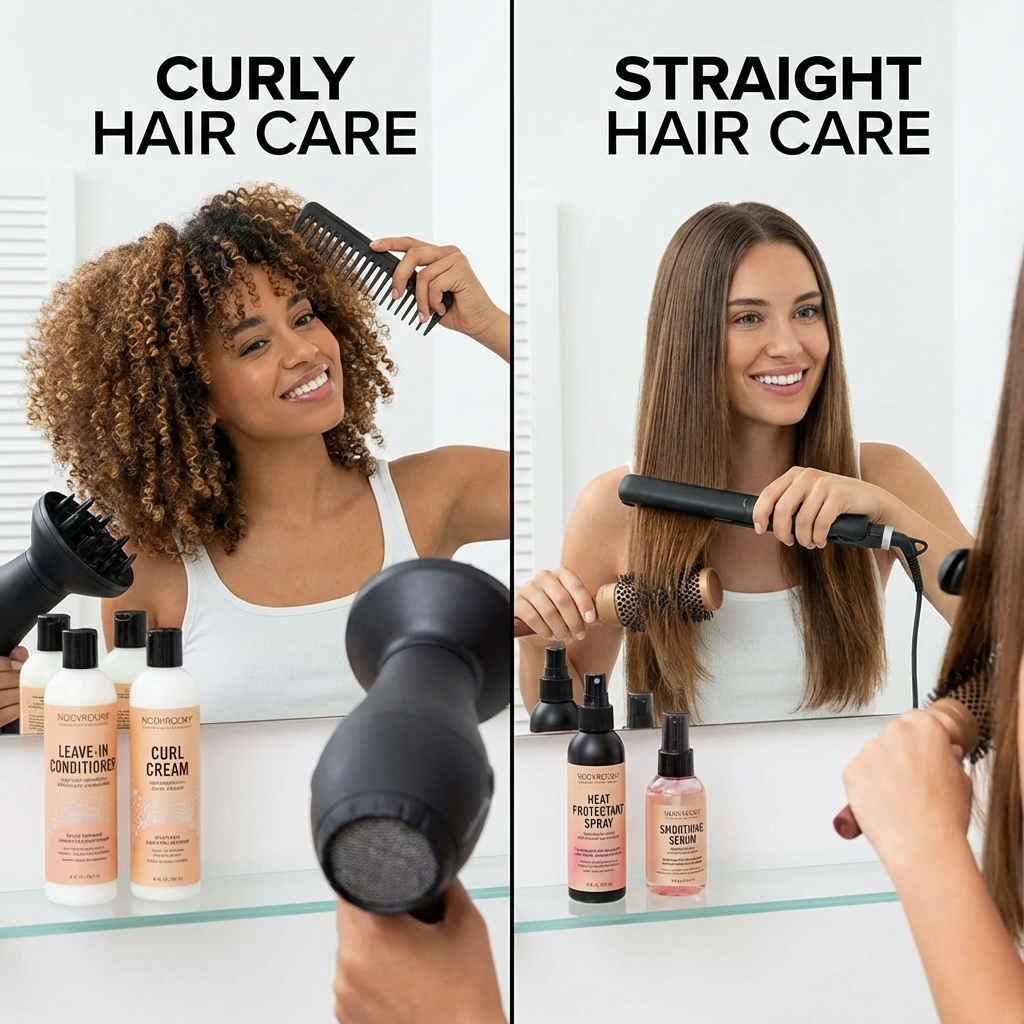
In the field of trichology, hair is not merely a cosmetic feature but a complex fiber governed by genetic geometry and lipid distribution. The biological requirements of a hair strand are determined almost entirely by the shape of the follicle from which it emerges. While straight hair benefits from a linear path for sebum distribution, curly hair faces structural challenges due to its elliptical shape and uneven cuticle thickness. Understanding the differences between curly and straight hair care requires a deep dive into the physics of the hair shaft and the biochemistry of the scalp’s natural oils.
As we move through 2026, personalized hair care has evolved to address these specific structural nuances, moving away from “one-size-fits-all” products toward targeted molecular formulas.
1. Morphological Foundations: The Ellipse vs. The Circle
The primary factor driving the differences between curly and straight hair care is the cross-sectional shape of the hair fiber. Straight hair typically emerges from a circular follicle, resulting in a perfectly cylindrical shaft. In contrast, curly hair emerges from an asymmetrical, hook-shaped follicle, producing an elliptical or flattened shaft.
This elliptical shape creates “stress points” along the curves of the hair strand. At every bend of a curl, the cuticle scales are slightly lifted or stretched thinner than on the straight sections. This makes curly hair inherently more porous and susceptible to mechanical damage. Consequently, care for curly hair must focus on “gap-filling” with proteins, whereas straight hair care focuses more on maintaining internal moisture without compromising volume.
2. Sebum Migration and the Lipid Barrier
The distribution of sebum—the scalp’s natural lubricant—is perhaps the most significant functional distinction in the differences between curly and straight hair care. On a straight hair shaft, sebum travels easily from the root to the tip via capillary action, providing a consistent protective coating. This often leads to “oily scalp, oily ends” syndromes, requiring frequent cleansing with surfactants.
In curly hair, the twists and turns of the fiber act as physical barriers to sebum migration. As a result, the scalp may remain oily while the mid-lengths and ends suffer from extreme lipid depletion. This is why curly hair requires “external lubrication” through oils and butters (like jojoba or shea), while straight hair requires lightweight, water-based humectants to avoid becoming weighed down or “greasy.”
3. Cuticle Architecture and Light Reflection
The way hair interacts with light is a direct result of its cuticle alignment. In straight hair, the cuticle scales lie flat and uniform, creating a smooth surface that reflects light evenly—this is what we perceive as “shine.” Care for straight hair often involves acidic rinses (pH 4.5–5.5) to keep these scales tightly sealed.
Curly hair, due to its coiled nature, has a more irregular surface. Light is scattered in different directions, resulting in a matte appearance often mistaken for “dullness.” One of the key differences between curly and straight hair care is the use of film-forming polymers in curly routines. These polymers create a synthetic smooth surface over the irregular cuticles, mimicking the reflective properties of straight hair while providing the “slip” necessary to prevent tangling.
4. Hygroscopy and the “Frizz” Phenomenon
Hygroscopy refers to a material’s ability to absorb moisture from the air. Because curly hair is naturally more porous at its bend points, it is highly sensitive to humidity. When the air is damp, the hair shaft swells unevenly, causing the curls to lose their pattern and result in “frizz.”
In the context of the differences between curly and straight hair care, frizz management for straight hair usually involves static reduction. However, for curly hair, it requires “hydrophobic sealing.” Curly hair routines in 2026 rely heavily on anti-humectants—ingredients that lock moisture inside the cortex while preventing atmospheric water from entering. Straight hair, conversely, rarely needs such heavy sealing and instead benefits from light proteins that provide “bounce” and structural rigidity.
5. Tensile Strength and Elasticity
Elasticity is the hair’s ability to stretch and return to its original shape without breaking. Curly hair generally has lower tensile strength than straight hair because the disulfide bonds (the “bridges” of the hair) are distributed unevenly across the elliptical shaft.
One of the vital differences between curly and straight hair care is the frequency and type of protein treatments. Straight hair can easily become “over-protienated,” leading to a stiff, straw-like texture. Curly hair, however, requires regular “micro-dosing” of hydrolyzed keratins or silk proteins to reinforce the stress points at the curves of the coils. This structural reinforcement is what allows a curl to maintain its “spring” or “memory” over time.
6. Cleansing Protocols: Surfactants vs. Co-Washing
The chemical approach to cleansing varies drastically between these two types. For straight hair, the goal is often the removal of excess sebum and environmental pollutants without stripping the internal moisture. Gentle sulfates or high-quality sulfonates are standard.
For curly hair, the “co-washing” (conditioner-only washing) or “low-poo” (low-surfactant) movement is based on the biological need to preserve every possible lipid. One of the major differences between curly and straight hair care is that curly hair can tolerate—and often thrives on—residual oils left behind after washing. For straight hair, this same residue would lead to “follicular clogging” and a lack of movement, potentially leading to scalp issues like seborrheic dermatitis.
7. Mechanical Stress and Detangling Physics
The physics of detangling is a critical area of study in trichology. Straight hair is best detangled when dry, as the hydrogen bonds are stable. However, curly hair should almost exclusively be detangled when saturated with water and a high-slip conditioner.
When curly hair is dry, the interlocking of the coils creates high friction. Attempting to brush dry curls causes “micro-tears” in the cuticle. Therefore, a primary rule in the differences between curly and straight hair care is the timing of mechanical intervention. Straight hair requires a soft-bristle brush to distribute oils, while curly hair requires wide-tooth combs or fingers to preserve the “clumping” of the curls and prevent the disruption of the natural pattern.
8. Conclusion: The Molecular Future of Hair Texture
In 2026, the industry has finally moved past the idea that “hair is just hair.” The differences between curly and straight hair care are rooted in the very DNA that determines our follicular shape. By respecting the elliptical geometry of curls or the cylindrical precision of straight hair, we can apply the correct balance of lipids, proteins, and pH-adjusters. Whether your goal is to enhance the sleek shine of straight locks or the resilient spring of tight coils, the answer lies in understanding the unique biophysical demands of your specific hair type.
Curly vs. Straight Hair Care FAQ
It’s all in the follicle shape. Round follicles produce straight hair, while oval or asymmetrical follicles create curly or wavy hair.
Natural scalp oils (sebum) have difficulty traveling down the spiral shape of curly hair, leading to less moisture at the ends compared to straight hair.
Yes! We use specialized shading and dot placement techniques to match the natural shadow and high-volume look of curly hair textures.
Straight hair usually shows thinning sooner because it lays flat. Curly hair can mask it longer with volume, but both benefit greatly from SMP density.
Yes. Our simulation is designed to look undetectable and natural whether you keep your curls or style your hair straight.
Straight hair scalps can become oily quickly, while curly hair scalps tend toward dryness. Maintaining a healthy scalp environment is key for pigment longevity.
The pigment is matched to your root color. The only difference is the technique used to blend the dots with your specific hair texture and flow.
Wait 3-4 days before washing. Then, use a mild, sulfate-free shampoo to protect both your hair’s natural texture and the new pigment.
Yes, hair simulation is an excellent way to fill in areas thinned by heat styling, chemical treatments, or mechanical breakage.
Light reflects differently on curls vs. straight hair. A professional analysis at hairsimulate.com ensures your SMP matches your unique hair pattern perfectly.